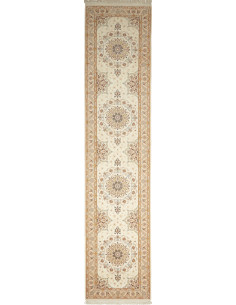
Isfahan Rugs: History, Characteristics, and Value of Persian Masterpieces. Discover the timeless charm of Isfahan rugs, icons of Persian textile art celebrated for their extremely fine knotting, floral motifs inspired by Safavid architecture, and their invaluable worth for collectors and luxury interior design.
Isfahan, located in central Iran, is one of the most celebrated cities of Persian culture and art, often referred to as “half of the world” for its architectural masterpieces, gardens, and artistic heritage. The tradition of Isfahan rug weaving is equally renowned and is considered among the finest in all of Persia. The golden age of Persian Isfahan rugs began during the Safavid dynasty, between the 16th and 17th centuries, when the royal court commissioned master weavers to create extraordinary carpets for palaces and mosques. Today, Isfahan continues to produce masterpieces that keep this glorious heritage alive.
The main characteristic of Isfahan rugs is the elegance of their design. They often feature a central medallion set within an open field, enriched by intricate arabesques, sinuous vines, and highly detailed floral motifs. Many decorative patterns draw direct inspiration from the tilework and architecture of Isfahan’s mosques and palaces, such as the Shah Mosque and Chehel Sotoun. The richly decorated borders complete the artwork with perfect symmetry.
Isfahan rugs are famous worldwide for their extremely fine knotting. They are crafted on silk or cotton warps, featuring a pile made of highest quality wool (often premium Kork wool), frequently enriched with inserts of pure silk. The knot density ranges from 600,000 to over 1,000,000 knots per square meter, allowing weavers to achieve an extraordinary level of detail. The surface appears smooth and delicate, resembling a painting woven with threads.
The color palette is refined and elegant. Ivory, cream, and light beige tones dominate the background, accompanied by indigo blue, turquoise, and crimson red. This carefully studied color balance provides a sense of sophistication and timeless beauty, making Isfahan rugs perfectly suited for both classical and modern environments.
Beyond their decorative purpose, Isfahan rugs are considered authentic cultural treasures. Many premium pieces are signed by master weavers, whose names are intricately knotted into the border, just like a painter's signature on a canvas. International collectors highly value these details, which attest to their authenticity, provenance, and artistic value.
Due to their delicacy and incredibly high knot density, Isfahan rugs are usually placed in prestigious locations, such as formal living rooms or reception halls, where they can be admired and preserved. They are rarely used in high-traffic areas, as their primary function is aesthetic rather than practical. For many owners, an Isfahan rug is not just a piece of furniture, but a true work of art destined to be passed down from generation to generation.
Today, Isfahan, alongside Nain and Ghom, is considered one of the three most prestigious textile centers in Iran. Its rugs embody centuries of Persian art, combining technical mastery and formal elegance, and they remain among the most sought-after and appreciated handcrafted artifacts in the world.